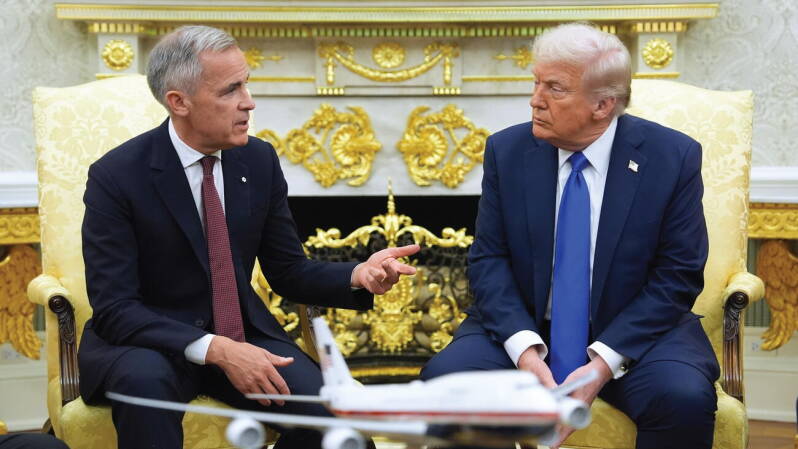
No, Mark Carney Did NOT Mock Trump at the G7 — Here's What Really Happened
Published: May 26, 2026 | Category: Deepfakes & AI Misinformation
THE CLAIM
Videos spreading across YouTube and social media in May 2026 alleged that Canadian Prime Minister Mark Carney publicly mocked U.S. President Donald Trump during a G7 news conference in Puglia, Italy. Titles like "13 Seconds That Shook the G7 Carney's Line That Triggered Global Laughter at Trump" racked up thousands of views in days, and some even linked to a deepfake version of Carney used to lure people into financial scams.
WHY IT'S FALSE
The videos do not show any actual footage of Carney mocking Trump because no such moment ever happened. Instead, each video features what appears to be a political analyst or geopolitical expert, supposedly on a video call, describing the alleged incident. But even that framing is fabricated.
There is also a basic factual error that should have been a red flag from the start: Italy hosted the G7 in 2024, not 2026. France holds the presidency in 2026. Carney did not even become Canada's Prime Minister until early 2025, meaning he could not have been at a 2024 Italy summit in that role. The entire premise falls apart upon the slightest scrutiny.
THE EVIDENCE
Multiple independent fact-checkers, including Snopes, CBC Fact Check, and Yahoo News, reviewed every version of the claim and reached the same conclusion: the videos are AI-generated.
YouTube itself applied labels to the videos, flagging them as "Altered or synthetic content." Reviewers at Snopes noted clear signs of AI generation throughout: unnatural blinking patterns, robotic head movements, an odd mechanical tone of voice, and an uncanny lack of natural human expressiveness. These are hallmarks of AI video synthesis tools that are now widely accessible to anyone with an internet connection.
CBC's investigation went further, uncovering that ads shared on Truth Social were linking directly to a deepfake of Carney designed not just to spread misinformation but to scam people out of money.
HOW TO SPOT AI-GENERATED VIDEOS LIKE THIS
This story is a textbook case of how AI misinformation is engineered to exploit emotion and trust. Here's what to watch for:
- Unnatural blinking or eye movement: AI avatars often blink too little or too much, or in irregular patterns.
- Robotic speech rhythm AI voices tend to lack natural pauses, emphasis shifts, and emotional intonation.
- No primary source footage. If a viral claim about a public event doesn't include actual footage of that event, be immediately skeptical.
- Check the basic facts first. Dates, locations, and timelines are easy to verify. If they're wrong, the whole story collapses.
- Look for platform labels. YouTube and Meta now apply AI-content labels. If you see one, slow down.
CONCLUSION
The viral claim that Mark Carney mocked Donald Trump at a G7 summit in Italy is completely fabricated, built on a false timeline, powered by AI-generated video, and in some versions, weaponized to defraud viewers. It is a near-perfect example of how synthetic media is being used to manufacture political drama that never occurred.
The antidote is not distrust of all information; it's slowing down, checking sources, and using tools designed to help you verify what you see. That's exactly what FactChecker Pro is built for.
Fact-checked using sources from Snopes, CBC Fact Check, and Yahoo News.
THE BROADER PATTERN: POLITICAL AI FAKERY IN 2026
The Carney deepfake does not exist in isolation. It is part of a rapidly expanding category of synthetic political content that targets the emotional fault lines between countries, leaders, and ideologies. In the first half of 2026 alone, fact-checkers have documented dozens of AI-generated videos falsely depicting world leaders making inflammatory statements, signing secret deals, or embarrassing themselves in public. The formula is consistent: a provocative headline, a short clip that looks like leaked footage, and a comment section designed to amplify outrage before any verification can take place.
What makes the Carney-Trump version particularly effective is that it exploits a real and ongoing tension. Canada and the United States have had a genuinely complicated relationship since the imposition of tariffs in 2025. Many viewers arrive at these videos already primed to believe that something dramatic could have happened at an international summit, because something dramatic has already been happening in real life. The fabricated clip does not need to be convincing on its own — it only needs to feel plausible enough that people do not stop to question it.
This is a documented psychological phenomenon known as the "continued influence effect": once a false claim has been accepted, correcting it requires far more cognitive effort than accepting it did in the first place. Misinformation researchers at the Reuters Institute have found that correction rates for AI-generated political content are significantly lower than for text-based falsehoods, precisely because video carries a stronger emotional imprint.
THE FINANCIAL SCAM CONNECTION
One dimension of this story that deserves more attention is the monetisation angle. CBC's reporting revealed that some versions of the fake Carney video were being used as click-through bait for investment scams — specifically, schemes designed to look like Carney was endorsing a cryptocurrency platform or an automated trading system. This is the same playbook used with deepfakes of Elon Musk, Rishi Sunak, and dozens of other public figures in recent years.
The sequence typically works like this: a platform runs paid social media ads using the AI-generated clip, targeting users who follow Canadian or political news. The ad redirects to a landing page that claims the celebrity endorsement is real and urges immediate investment to secure a limited spot. Users who sign up hand over personal and financial details to a fraudulent operation that has no connection to the person depicted.
This means that the harm from the Carney video was not merely reputational or informational. For some viewers, it was financial. Fact-checking the viral claim was not just an exercise in media literacy — it was a form of consumer protection. Every person who paused to verify before clicking potentially avoided a scam.
FactChecker Pro flags content of this type in real time as you browse. When you see a video claim involving a public figure and an investment product, the extension cross-references known scam patterns and credibility signals before the page even fully loads. The two-second window before you share or click is exactly when that check matters most.
Add comment
Comments